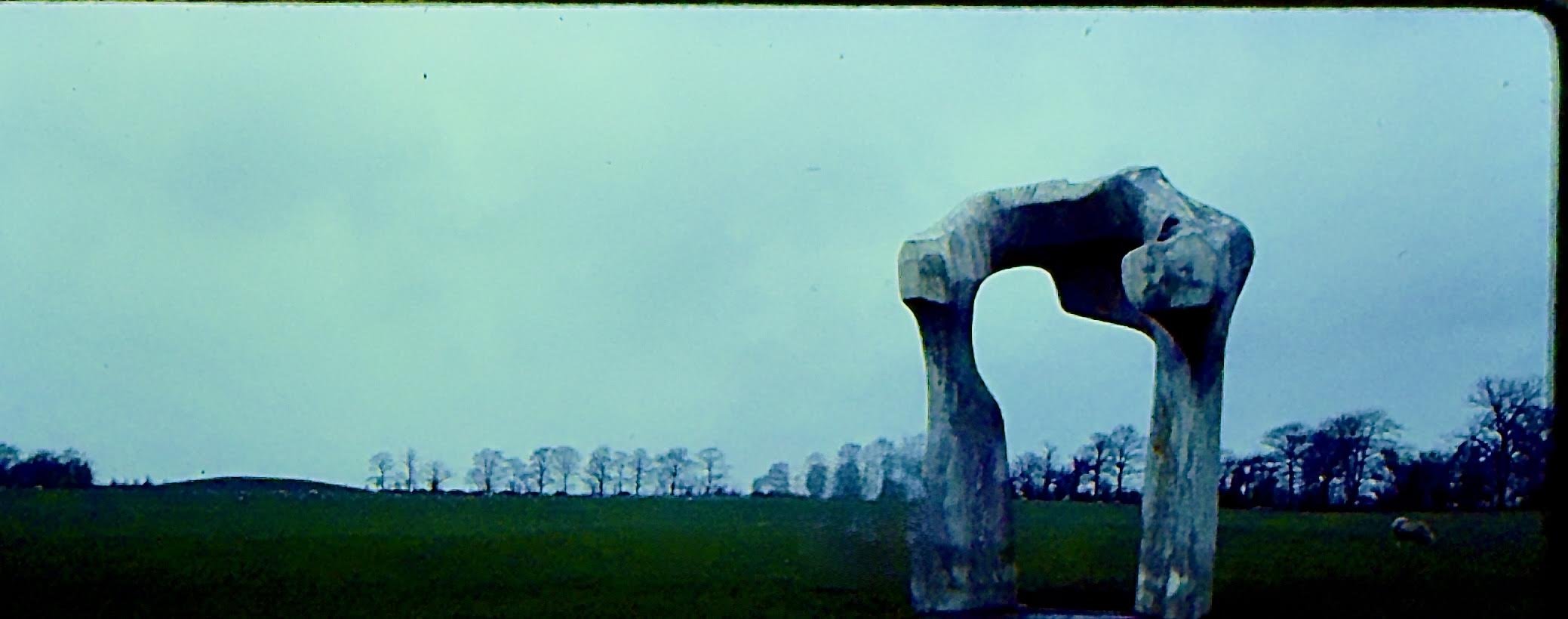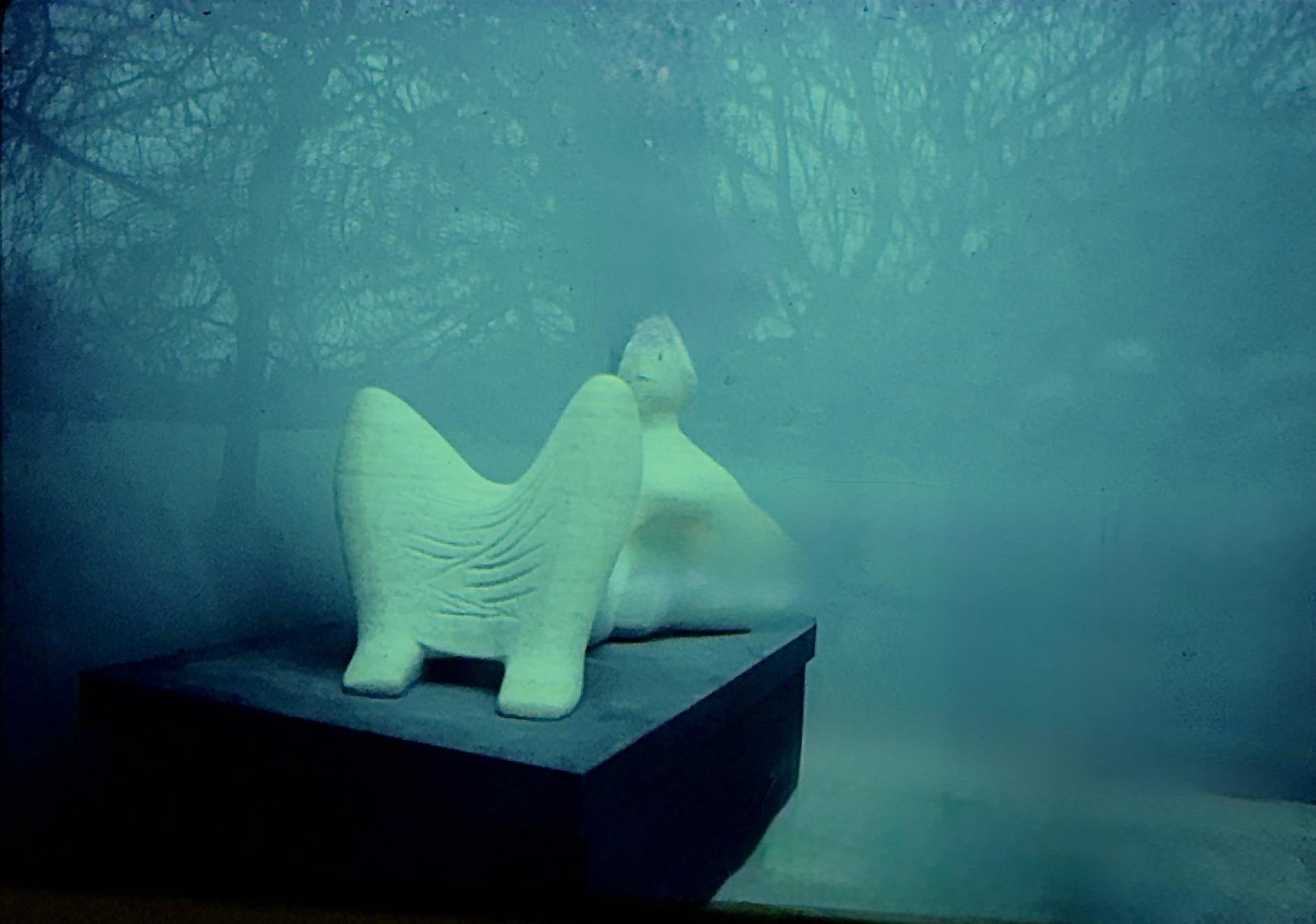
A sculpture on Henry Moore’s property
Truthful Fictions
Truthful Fictions are my cultural phantasms: one day is better than another, and the end of one day leads into the next.
At a very young age in a matter of seconds, I was the man who fell to earth.
Whispers were summoned: Above the grass like elfin neighbors of nature, we walked abreast into those incandescent sounds. Two minds with diverging interests and destinations motoring forward. Like in life we didn’t hold hands. We didn’t look at each other. We maintained our steps in the grass.
The unmistakable from nearby kingdoms aired like a united coalition of Christian choirs in melodious songs. The King’s and Queen’s United Kingdom called out. The twentieth-century icon heard his nation’s entreaties: Accented histories, “The Sylvan land, The Cluain land, The Coill land, The Bonnie, The hint of Cynefin.” The artist Henry Moore, would not have wanted it another way. The land enveloped the Kingdoms’ history of sights and sounds.
Alone with my memory, I can still recall the blackness of the camera shutter curtain sliding at least once. Prose written by the philosophical and the romantic walked the land centuries before Henry Moore and Richard Schulman. For those who toed the lines, the blades of grass painted words above and below for the pastorally inclined to wade through. What did the centuries behind look like to me? What were the paths of thought, romance and fictional prose hidden in plain sight?
There were birds of foreign heritages. Flocks of many petitioned our stroll invasively. We moved in quiet mode. I remember hearing the echoes reverberating in my single frame. I did not intend to poeticize the moment nor the day, yet there we were, two men separated by a slew of decades. It was truthful fiction motivating my sight to see what may be here in there. I needed to account for a setup of each new frame.
That day’s memory would never be repeated nor reenacted in my time. I felt like a character in writings I palpably remembered. There was a topographical, lyrical, and evocative blending of nature’s precision.
My long strides moved to synchronize with the little man aside. He had so many lives to share, stories to share. He joined the moment like no other had or ever would.
At twenty-something I was afraid for what I was supposed to do. The black shutter curtain lifted, sat again, and maybe moved one more time. It is incredibly fast but I prefer a slow methodical motion to appreciate what the camera might have seen. An inviting language can be heard: It is the beautiful elegance of grassland posing as a kingdom in the United Kingdom.
2: I made an image as I stood on my toes as a dancer in soft shoes. The frame was a Kodachrome celluloid 35mm, sized 36mm by 24mm. Maybe it was closer to 1.42 inches x 0.94 inches. I was walking on Henry Moore’s countryside. I played the Neil Young lyrics in my mind over and over. ‘Old man, look at my life, I’m a lot like you were, Old man, look at my life, I’m a lot like you were.’—Neil Young
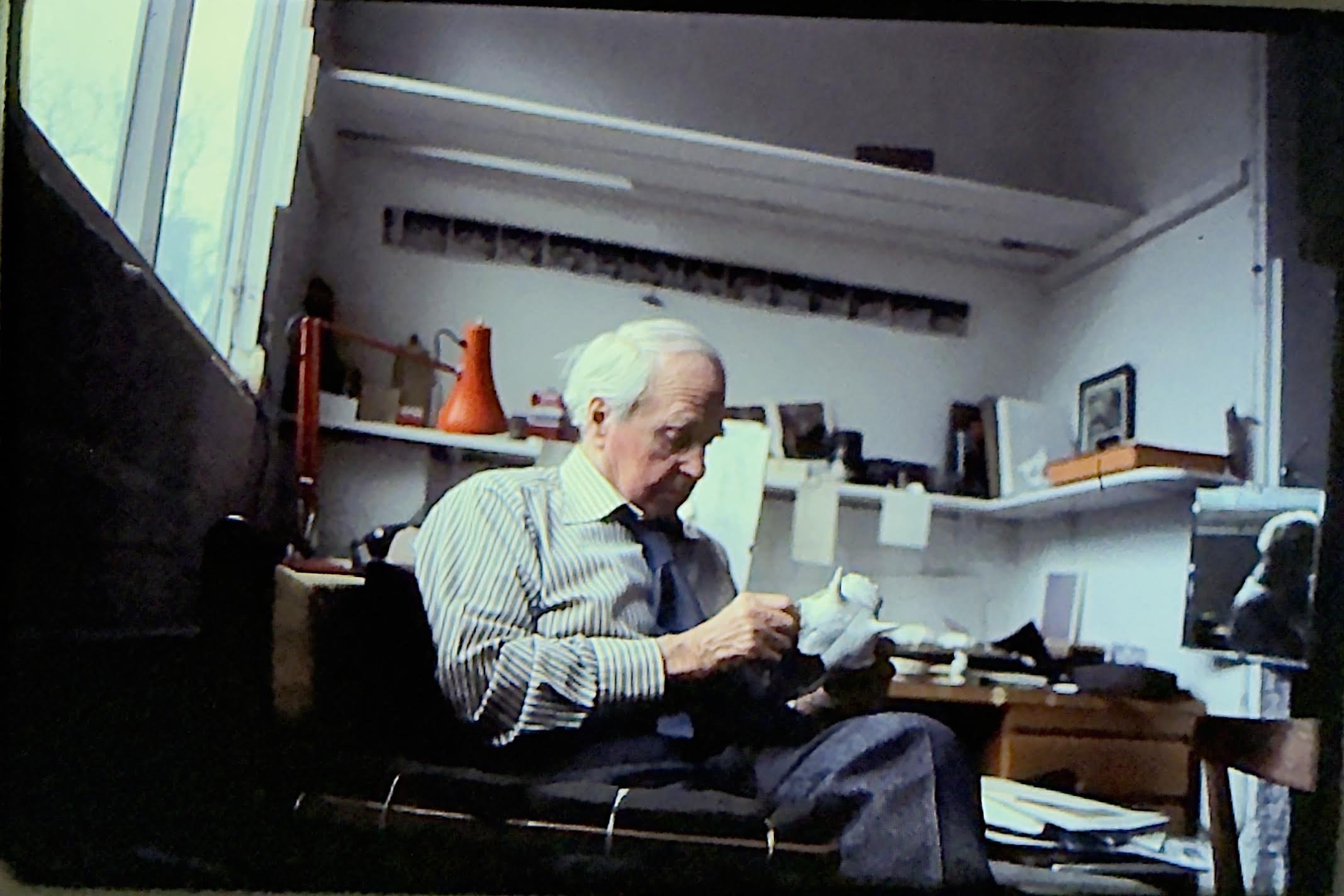
Henry Moore Sketching
Henry Moore one of the finest names in 20th century art led me to places I will never know again.
In a significant way, there was just this old man almost sixty years my senior in step with me… but he wasn’t just my old man. He was a brilliant self-appointed rascal. King and country foremost in his mind.
When I first shook the hands of this giant little man, it was at a table of many for lunch.
He was art history. The moment was like an alchemical fix: my endorphins and adrenaline mixed, and stirred hallucinating imaginations. I was instantly celebrating being in Lewis Carroll’s Alice in Wonderland — Beatrice Potter’s, Br’er Rabbit. The image of the rabbit holding the skirt of Alice was not real. I was a very young photographer iris to iris with a storied figure in 20th-century art. Why wouldn’t fiction become reality, reality seem fictitious?
Talking among many at a lunch in my honor, the prickly huff-and-puff Englishman didn’t quite enjoy the attentions directed elsewhere: It might have been something to do with my admiring comment about Richard Attenborough’s great Gandhi film. I was not prepared for a loyalist in the room. Certainly that was my mistake not to be able to read political passions. I figured it out quickly when the great artist walked away from the table, leaving me to commune with nature and mingle with the sheep-like homesteaders who watched my gait with a healthy laughter. It was okay to be left alone in transcendental fields of grass.
I knew Moore was headed back to his studio. I wondered if there was a remnant of his fabulous World War 2 Underground sketches: the penciled work that made me tear when I first saw them.
I caught up with him at his studio. I watched him sketch. I watched him knowing he was a reminder of an era not mine. This was Henry Moore knowingly or not rehearsing for a close-up with my camera. All I could see was a surrealist idea of an artist making lovely work with a pencil in hand.
I had a pocketful of assorted ology’s to keep me thoughtful in this moment. I have always traveled with something to think about more than a single photograph. I conjured a few gems to help me focus on what I knew what the camera may discover. Roger Fenton’s Rievaulx Abbey, and the Bisson Frères Portal of Saint-Ursin, Bourges often remind me of the heights of visual captures I will never equal. Oh, but the joy of hearing the black shutter curtain snap is the prodigious sound that keeps me alive.